OCPP 1.6 vs OCPP 2.0.1 — What EV Charging Operators Should Know
Compare OCPP 1.6 vs OCPP 2.0.1 features, security, smart charging, compatibility, and benefits for EV charging operators.
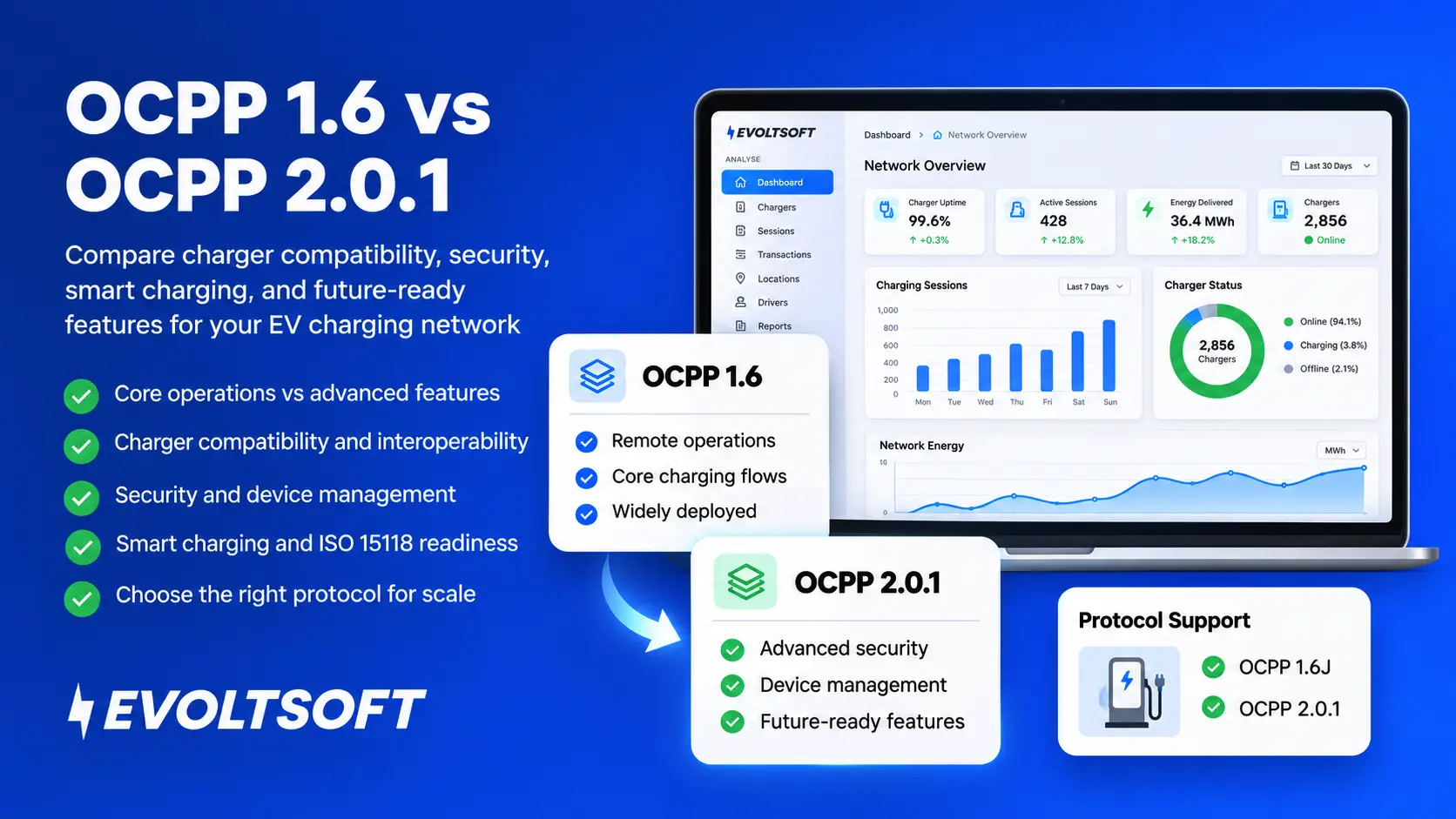
OCPP 1.6 vs OCPP 2.0.1: What EV Charging Operators Should Know
As electric vehicle charging networks continue to expand, choosing the right charging infrastructure and software has become increasingly important for Charge Point Operators (CPOs).
One of the most important technical considerations is the Open Charge Point Protocol (OCPP), which enables communication between EV charging stations and their backend management systems.
Two widely recognized versions are OCPP 1.6 and OCPP 2.0.1.
While OCPP 1.6 remains widely deployed across charging networks, OCPP 2.0.1 introduces advanced functionality for security, device management, smart charging, and transaction handling.
But does every charging operator need OCPP 2.0.1? Is OCPP 1.6 still a good choice? And what should CPOs consider before investing in charging hardware?
This guide explains the key differences, capabilities, and practical considerations to help operators make informed decisions.
What Is OCPP in EV Charging?
OCPP stands for Open Charge Point Protocol. It is an open communication standard developed and maintained by the Open Charge Alliance (OCA).
It enables EV charging stations to communicate with a Charging Station Management System (CSMS).
For example, when a driver connects their electric vehicle and starts charging, OCPP allows the charger and backend platform to exchange information about authorization, session status, energy consumption, and charging operations.
Through OCPP, a charging management platform can perform functions such as:
- Monitor charging station availability
- Authorize charging sessions
- Start and stop charging remotely
- Receive energy consumption data
- Monitor connector status
- Access diagnostic information
- Manage charger configurations
- Apply supported smart charging profiles
- Support maintenance operations
The biggest advantage of OCPP is interoperability.
Operators can potentially manage chargers from multiple manufacturers through a single OCPP-compatible backend, reducing dependency on proprietary software.
However, actual interoperability still depends on protocol versions, supported features, and successful integration testing.
What Is OCPP 1.6?
OCPP 1.6 was released in 2015 and became one of the most widely implemented communication protocols in the EV charging industry.
It supports essential charging operations and introduced capabilities such as smart charging profiles, improved status reporting, and local authorization list management.
OCPP 1.6 supports both SOAP and JSON implementations, although OCPP 1.6J, which uses JSON over WebSocket, is especially common in modern charging deployments.
Key Features of OCPP 1.6
1. Charging Session Management
Allows charging stations to communicate transaction start, transaction stop, and meter values to the backend.
2. Remote Charger Operations
Supports remote start, remote stop, charger reset, and other operational commands.
3. Charger Status Monitoring
Provides information about charger states such as Available, Preparing, Charging, SuspendedEV, SuspendedEVSE, Finishing, and Faulted.
4. Smart Charging Profiles
Supports charging schedules and charging power or current limits through supported charging profiles.
5. RFID and User Authorization
Enables backend authorization and local authorization mechanisms for charging access.
6. Firmware and Diagnostics Management
Supports firmware update requests and the retrieval of diagnostic information from compatible chargers.
When Is OCPP 1.6 Suitable?
OCPP 1.6 can remain a practical option for:
- New public charging networks
- Residential and commercial charging
- Workplace charging
- Destination charging
- Fleet charging deployments
- Networks using existing OCPP 1.6-compatible chargers
For operators whose priority is reliable charging sessions, billing, remote operations, and basic smart charging, OCPP 1.6 may provide the functionality they need.
What Is OCPP 2.0.1?
OCPP 2.0.1 was released in 2020 as a major evolution of the OCPP standard.
It was developed to address operational challenges, improve security, provide more detailed charger information, and enable advanced functionality required by increasingly sophisticated charging infrastructure.
Unlike a minor software update, OCPP 2.0.1 introduces substantial changes in protocol structure and communication behavior.
Its most important improvements include device management, transaction handling, security, smart charging, and ISO 15118 integration.
Key Features of OCPP 2.0.1
1. Advanced Device Management
OCPP 2.0.1 introduces a structured device model that enables more detailed monitoring and configuration of charging station components and variables.
This helps operators gain better visibility into supported hardware configurations and operational information.
2. Improved Transaction Handling
OCPP 2.0.1 uses a revised transaction event model, allowing more flexible transaction start and end conditions.
This helps charging systems manage complex charging behaviors more consistently.
3. Enhanced Security
OCPP 2.0.1 provides a more comprehensive security framework, including security profiles, certificate-related functionality, and secure communication capabilities.
4. Advanced Smart Charging
The protocol expands smart charging functionality to support more sophisticated charging schedules and energy management use cases.
5. ISO 15118 Integration
OCPP 2.0.1 introduces standardized support for functions related to ISO 15118, including Plug & Charge certificate management.
6. Display and Messaging Support
Compatible charging stations can support richer communication involving display messages and driver-facing information.
These capabilities make OCPP 2.0.1 particularly relevant for operators planning complex, large-scale, or advanced charging deployments.
OCPP 1.6 vs OCPP 2.0.1: Feature Comparison
Understanding the differences between the two protocols can help operators decide which version is more appropriate for their charging business.
Protocol and Communication
OCPP 1.6: Supports SOAP and JSON implementations, with JSON over WebSocket commonly used.
OCPP 2.0.1: Uses JSON over WebSocket and introduces a substantially revised protocol structure.
Charger Monitoring
OCPP 1.6: Supports charger status, connector availability, diagnostics, and basic configuration management.
OCPP 2.0.1: Adds a structured device model for more detailed component monitoring and configuration.
Transaction Management
OCPP 1.6: Uses messages such as StartTransaction, StopTransaction, and MeterValues.
OCPP 2.0.1: Uses TransactionEvent messages with a more flexible transaction handling model.
Security
OCPP 1.6: Supports security enhancements through standardized extensions and implementation choices.
OCPP 2.0.1: Provides a more integrated and comprehensive security architecture.
Smart Charging
OCPP 1.6: Supports charging profiles and load management functionality.
OCPP 2.0.1: Expands smart charging capabilities for more advanced energy management scenarios.
Plug & Charge
OCPP 1.6: ISO 15118 functionality can be supported through extensions and additional implementation work.
OCPP 2.0.1: Includes standardized protocol support for ISO 15118-related operations.
Device Configuration
OCPP 1.6: Primarily uses configuration keys and supported management commands.
OCPP 2.0.1: Introduces the component-and-variable device model for more granular management.
Compatibility
OCPP 1.6 and OCPP 2.0.1 are not backward compatible.
A charging station supporting only OCPP 1.6 cannot communicate using OCPP 2.0.1 without an appropriate implementation or upgrade.
Similarly, a backend supporting only one version cannot automatically communicate using the other.
Why OCPP 2.0.1 Matters for EV Charging Operators
The advantages of OCPP 2.0.1 become more relevant as charging networks grow and operational requirements become more demanding.
1. Better Visibility Into Charger Operations
Traditional monitoring may show whether a charger is online, offline, or faulted.
Advanced device management can provide more detailed information about the charging station's components and configuration.
This allows operators to understand supported charger behavior more precisely.
2. Stronger Security Capabilities
Charging networks exchange operational commands, authorization information, and transaction data.
Improved security mechanisms help charging operators strengthen their infrastructure and meet increasingly demanding security expectations.
However, choosing OCPP 2.0.1 alone does not automatically make a charging network secure. Correct implementation, certificate management, infrastructure protection, and operational procedures remain essential.
3. Greater Flexibility for Smart Charging
As charging networks expand, managing available electrical capacity becomes increasingly important.
OCPP smart charging functionality can help operators apply supported charging limits and schedules.
OCPP 2.0.1 provides additional capabilities for more sophisticated implementations, making it relevant for installations with complex energy management requirements.
4. Improved Support for Future Charging Technologies
Advanced charging experiences increasingly involve charger-to-vehicle communication, automation, and more detailed device interactions.
OCPP 2.0.1 provides a stronger foundation for ISO 15118-related integrations and future charging functionality.
However, features such as Plug & Charge require compatible charging hardware, vehicle support, certificates, and backend integration.
Does OCPP 2.0.1 Automatically Improve Charger Uptime?
Not necessarily.
OCPP 2.0.1 provides additional monitoring and diagnostic capabilities that can help charging operators detect and investigate problems.
However, charger uptime also depends on:
- Hardware reliability
- Network connectivity
- Firmware quality
- Backend availability
- Maintenance processes
- Electrical infrastructure
- Monitoring and alerting systems
A well-integrated OCPP 1.6 charger can perform more reliably than a poorly implemented OCPP 2.0.1 charger.
Operators should evaluate actual charger performance rather than assuming a newer protocol guarantees better uptime.
Can OCPP 1.6 Chargers Be Upgraded to OCPP 2.0.1?
This depends on the charger manufacturer and hardware capabilities.
Some chargers may support multiple OCPP versions through firmware or configurable communication settings.
Other chargers may require substantial firmware changes or hardware replacement.
Before purchasing equipment, operators should confirm:
- Which OCPP versions the charger supports
- Whether a future firmware upgrade is available
- Whether the charger has been tested with the intended backend
- Which optional OCPP features are implemented
- Whether the charger manufacturer provides ongoing firmware support
- Whether OCPP certification is available for the relevant model and version
A charger marketed as OCPP-compatible may not support every optional feature in the protocol.
Should New Charging Networks Choose OCPP 1.6 or OCPP 2.0.1?
There is no single answer for every charging business.
The right choice depends on your project requirements, charger hardware, operating model, and long-term expansion plans.
Choose OCPP 1.6 When:
- You are launching with established OCPP 1.6-compatible chargers
- Your requirements focus on standard charging operations
- You need remote monitoring and session management
- Basic smart charging functionality is sufficient
- Your hardware supplier provides reliable OCPP 1.6 integration
Consider OCPP 2.0.1 When:
- You are purchasing new charging hardware
- Advanced device management is important
- You require a more comprehensive security framework
- Your project involves sophisticated smart charging requirements
- You are planning ISO 15118-related functionality
- You want to support increasingly advanced charging infrastructure
For many operators, the ideal approach is to choose a charging management platform capable of supporting both OCPP 1.6J and OCPP 2.0.1.
This provides flexibility when working with different charger manufacturers and hardware generations.
What About OCPP 2.1?
The EV charging industry continues to evolve beyond OCPP 2.0.1.
The Open Charge Alliance released OCPP 2.1 in 2025, introducing additional functionality for bidirectional charging, distributed energy resource integration, battery swapping, and advanced charging workflows.
OCPP 2.1 builds on OCPP 2.0.1 and was designed to maintain compatibility with OCPP 2.0.1 application logic.
Operators planning long-term infrastructure investments should also evaluate the roadmap for OCPP 2.1, while confirming the actual capabilities supported by their chosen hardware and backend software.
Why Your EV Charging Software Should Support Multiple OCPP Versions
Many charging networks operate equipment from different manufacturers.
Some chargers may support OCPP 1.6J, while others may use OCPP 2.0.1.
Managing these chargers through separate software systems can create operational complexity.
A charging management platform supporting multiple OCPP versions can help operators:
- Manage different charger brands
- Reduce software fragmentation
- Maintain centralized operational visibility
- Support gradual hardware upgrades
- Simplify charger onboarding
- Scale without replacing existing infrastructure unnecessarily
For growing CPOs, this flexibility can be a major advantage.
How Evoltsoft Supports OCPP-Based EV Charging Networks
Evoltsoft provides white-label EV charging management software designed to help Charge Point Operators manage charging infrastructure through a centralized platform.
The platform supports OCPP 1.6J and OCPP 2.0.1, allowing operators to work with compatible chargers across different hardware generations.
Key platform capabilities include:
- OCPP-based charger connectivity
- Real-time charger and connector monitoring
- Charging session management
- Remote charger operations
- Charger status and diagnostic information
- Tariff and billing management
- Payment gateway integrations
- White-label mobile applications
- EV driver web app
- Reports and analytics
- Partner and location management
Evoltsoft also supports charger onboarding and integration testing, helping operators validate charger compatibility before production deployment.
As an Open Charge Alliance member, Evoltsoft is part of the broader ecosystem supporting open standards in EV charging.
Final Checklist Before Choosing an OCPP-Compatible Backend
Before selecting EV charging management software, ask your provider:
- Does the platform support both OCPP 1.6J and OCPP 2.0.1?
- Can it connect to chargers from different manufacturers?
- Does it support remote start, stop, reset, and diagnostics?
- Can operators monitor charger status and charging sessions in real time?
- Are smart charging profiles supported for compatible chargers?
- Does the platform provide secure communication and appropriate access controls?
- Can the provider assist with charger testing and onboarding?
- Does the system support billing, payments, and reporting?
- Can the platform scale as new locations and chargers are added?
- Is there a clear roadmap for supporting future protocol requirements?
These questions help ensure you are selecting more than a communication server. You are choosing the operational foundation for your charging business.
Final Thoughts
OCPP 1.6 and OCPP 2.0.1 both play important roles in the EV charging industry.
OCPP 1.6 remains a practical and widely deployed solution for standard charging operations.
OCPP 2.0.1 introduces advanced functionality for device management, security, transaction handling, smart charging, and ISO 15118 integration.
For CPOs, the best decision is not simply to choose the newest protocol. It is to select a combination of charging hardware and backend software that supports current business requirements while allowing room for future growth.
Looking for OCPP-compatible EV charging management software?
Evoltsoft helps charging operators launch and scale with a white-label platform supporting OCPP 1.6J and OCPP 2.0.1.
Book a Demo with Evoltsoft and explore how our charging management platform can support your network.