CPO vs eMSP: Key Differences in EV Charging Software | Evoltsoft
Understand CPO vs eMSP in EV charging software and learn which platform features your charging business needs.
CPO vs eMSP: What’s the Difference in EV Charging Software?
The EV charging business has many moving parts. Chargers, drivers, apps, payments, tariffs, roaming, billing, support, and network operations all need to work together smoothly.
Two of the most important roles in this ecosystem are CPO and eMSP.
If you are planning to launch an EV charging business, understanding the difference between a CPO and an eMSP is important. It helps you decide what kind of EV charging software you need, which features matter most, and how your business will operate.
Some companies operate only as CPOs. Some operate only as eMSPs. Many modern EV charging businesses do both.
This guide explains the difference between CPO and eMSP, how each role works, and what software features are required for each business model.
What Is a CPO in EV Charging?
A CPO, or Charge Point Operator, is the business that owns, manages, or operates EV charging stations.
The CPO is responsible for keeping chargers available, connected, maintained, priced, and ready for drivers to use.
A CPO may own the chargers directly, or it may operate chargers on behalf of site owners, commercial properties, fleets, parking operators, hotels, malls, workplaces, or public charging networks.
In simple terms:
The CPO manages the charging infrastructure.
What Does a CPO Do?
A CPO is usually responsible for:
- Installing or operating EV chargers
- Connecting chargers to a backend platform
- Monitoring charger status
- Managing charger availability
- Setting tariffs and pricing
- Handling charging sessions
- Managing maintenance and faults
- Tracking revenue and usage
- Managing site owners or location partners
- Providing support when chargers do not work properly
For example, if a charger is offline, faulted, or not starting a session, the CPO is usually responsible for resolving the issue.
What Software Does a CPO Need?
A CPO needs strong backend software to manage the operational side of the charging network.
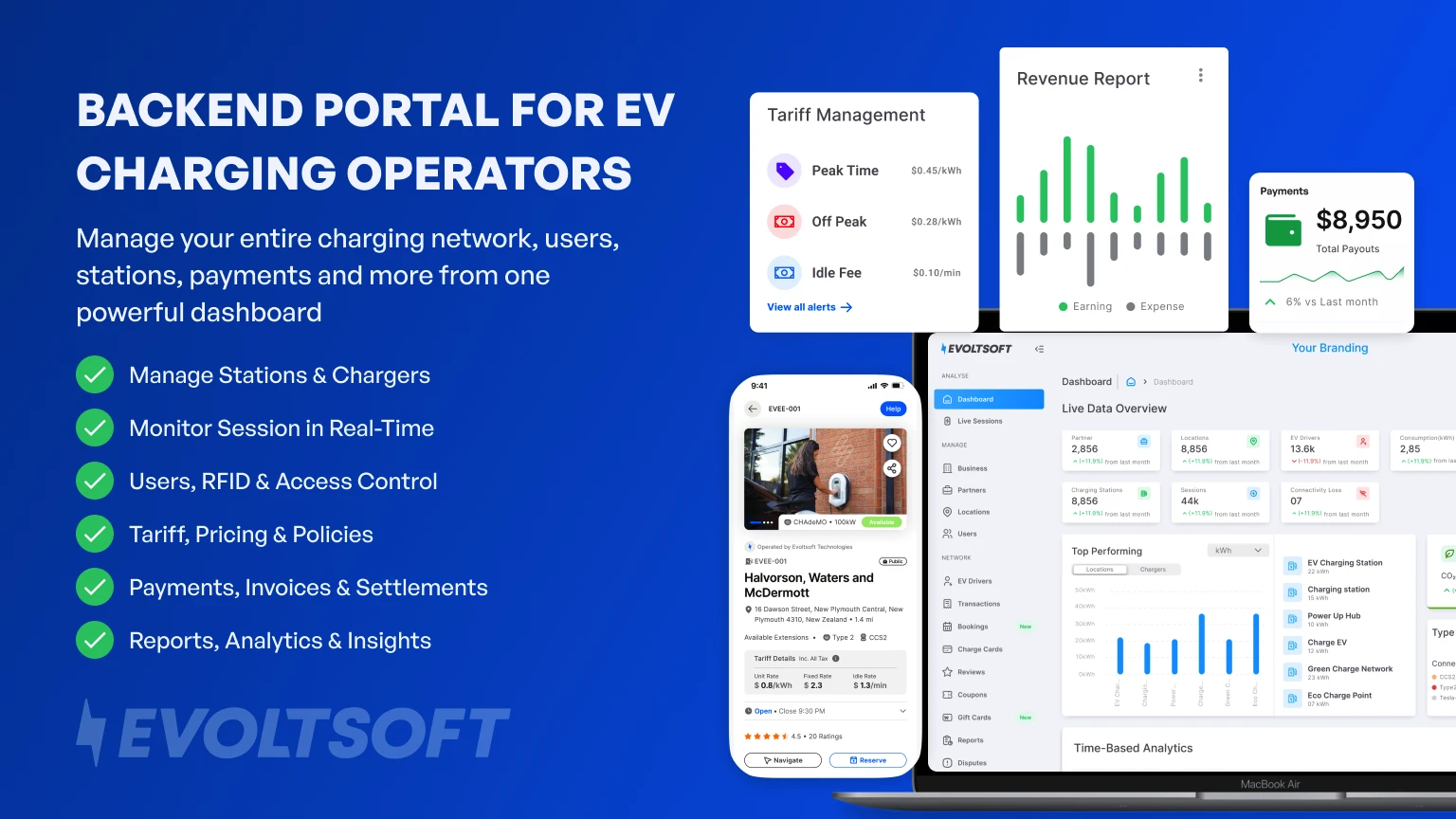
Important CPO software features include:
- OCPP charger management
- Real-time charger monitoring
- Connector-level status tracking
- Remote start and stop
- Remote reset
- Charger logs and diagnostics
- Tariff management
- Session monitoring
- Revenue tracking
- Reports and analytics
- Site and location management
- Partner management
- Uptime tracking
- Maintenance workflows
- OCPI support for roaming, if required
For CPOs, the backend portal is the control center of the business.
What Is an eMSP in EV Charging?
An eMSP, or e-Mobility Service Provider, is the business that provides EV drivers with access to charging services.
The eMSP usually manages the customer-facing experience. This may include the mobile app, driver account, payment methods, charging history, station discovery, subscriptions, roaming access, and customer support.
In simple terms:
The eMSP manages the driver relationship.
The eMSP may not own the chargers. Instead, it may connect drivers to chargers operated by different CPOs through direct integrations or roaming agreements.
What Does an eMSP Do?
An eMSP is usually responsible for:
- Offering an EV driver mobile app
- Helping users find charging stations
- Showing charger availability
- Managing user accounts
- Supporting payments
- Providing invoices and receipts
- Offering subscriptions or memberships
- Managing RFID cards or tokens
- Supporting roaming access
- Handling driver-facing support
- Managing charging history and wallet balance
For example, when a driver opens an app, finds a nearby charger, starts a session, and pays through the app, that experience is typically managed by the eMSP.
What Software Does an eMSP Need?
An eMSP needs software that focuses on the driver experience and user access.
Important eMSP software features include:
- EV driver mobile app
- EV user web app
- Station map and list view
- Charger availability display
- User account management
- Wallet and card payments
- RFID or token management
- Charging history
- Invoices and receipts
- Notifications
- Reviews and ratings
- Subscriptions or memberships
- Coupons and promotions
- OCPI roaming support
- Customer support tools
For eMSPs, the mobile app and user experience are central to the business.
CPO vs eMSP: Simple Difference
The easiest way to understand the difference is this:
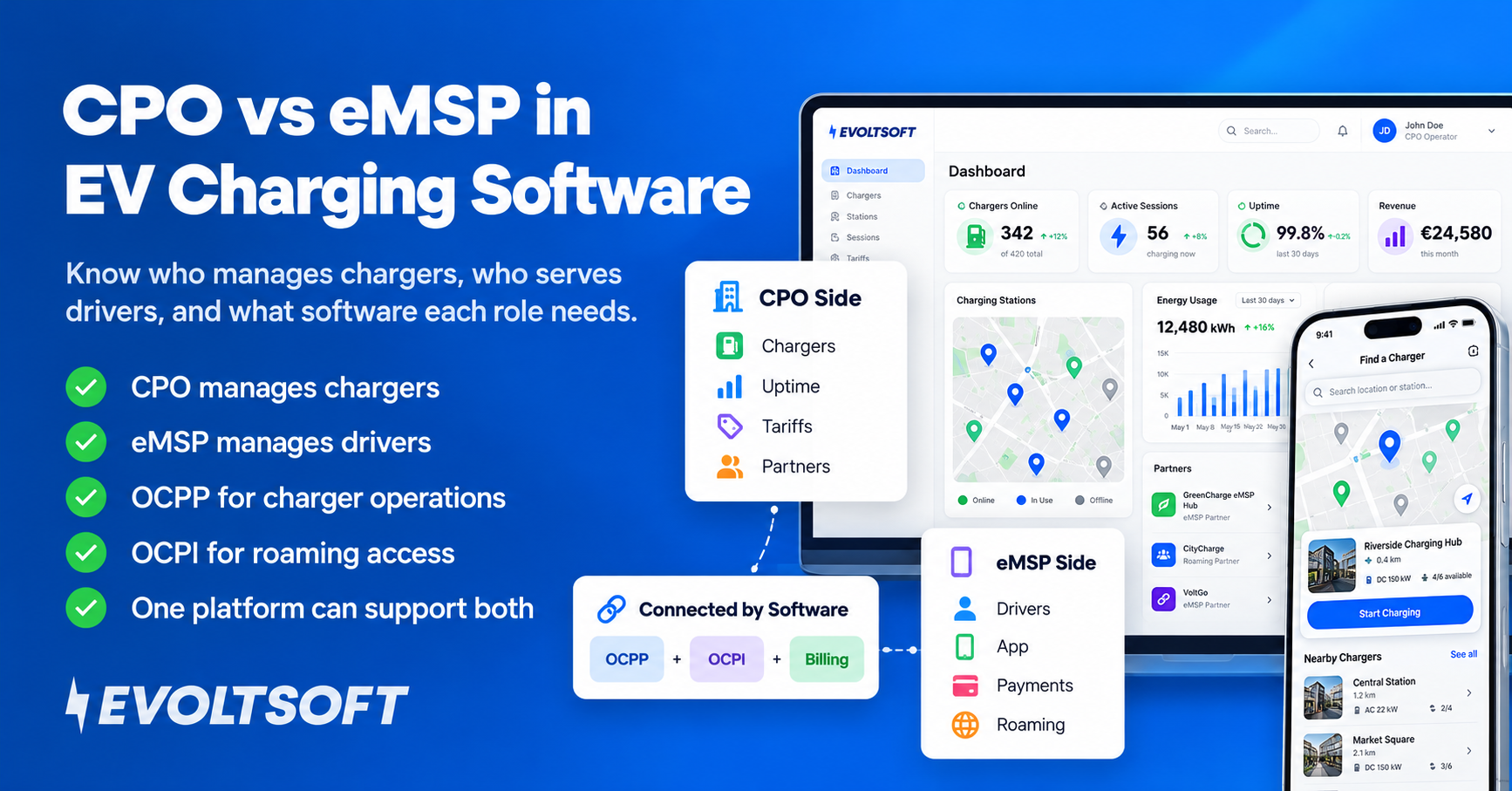
CPO = manages chargers
eMSP = manages drivers
A CPO focuses on infrastructure, uptime, charger operations, site management, tariffs, and network performance.
An eMSP focuses on user access, mobile apps, payments, roaming, driver accounts, and customer experience.
Both roles are connected, but they solve different problems.
CPO vs eMSP: Feature Comparison
CPO vs eMSP: Feature Comparison
Main role
CPO: Operates chargers
eMSP: Serves EV drivers
Primary focus
CPO: Infrastructure management
eMSP: Driver experience
Main software
CPO: Backend portal
eMSP: Mobile app and user platform
Key protocol
CPO: OCPP
eMSP: OCPI
Charger ownership
CPO: Usually owns or operates chargers
eMSP: Does not necessarily own chargers
Tariff management
CPO: Usually manages tariffs
eMSP: May display or apply tariffs
User management
CPO: Sometimes
eMSP: Yes
Payment management
CPO: Depends on the business model
eMSP: Usually manages driver-facing payments
Maintenance
CPO: Responsible for charger operations and maintenance
eMSP: Usually not responsible
Roaming
CPO: Optional depending on network strategy
eMSP: Often important
Can a Company Be Both CPO and eMSP?
Yes. Many EV charging businesses operate as both CPO and eMSP.
For example, a company may:
- Own or operate chargers
- Launch its own branded mobile app
- Allow drivers to register and charge
- Collect payments directly
- Manage tariffs and invoices
- Offer RFID cards or subscriptions
- Connect to roaming networks later
In this model, the company is managing both the infrastructure side and the driver-facing side.
This is common for public charging networks, white-label EV charging businesses, fleet charging operators, and regional charging brands.
Why the Difference Matters When Choosing Software
Understanding whether you are a CPO, eMSP, or both helps you choose the right EV charging software.
If you are only a CPO, your biggest priorities may be charger monitoring, OCPP compatibility, tariffs, diagnostics, reports, partner management, and uptime.
If you are only an eMSP, your biggest priorities may be mobile app experience, user management, payments, subscriptions, RFID, roaming, and customer support.
If you are both, you need a complete platform that supports backend operations and driver-facing services together.
Choosing software without understanding this difference can lead to missing features, operational gaps, or expensive custom development later.
The Role of OCPP for CPOs
OCPP is one of the most important protocols for CPOs.
It allows chargers to communicate with the backend platform. Through OCPP, the CPO can monitor chargers, receive status updates, start or stop sessions, receive meter values, and manage charger operations.
For CPOs, OCPP support is essential because it helps avoid vendor lock-in and allows different charger brands to connect to the same backend platform.
A strong CPO platform should support OCPP-based charger management and provide clear visibility into charger behavior.
The Role of OCPI for CPOs and eMSPs
OCPI is important when charging networks need interoperability.
It allows CPOs and eMSPs to exchange information such as station locations, charger availability, tariffs, tokens, sessions, and charging records.
For CPOs, OCPI can help expose chargers to external eMSPs or roaming partners.
For eMSPs, OCPI can help provide drivers access to chargers from different networks.
If your business plans to support roaming, OCPI readiness should be part of your software evaluation.
Common Business Models
1. Pure CPO Model
In this model, the company focuses on operating chargers.
The CPO may provide charger access through a basic app, web app, RFID, or roaming partners, but the main focus is infrastructure operations.
This model is common for businesses that own charging stations or operate them for site hosts.
2. Pure eMSP Model
In this model, the company focuses on drivers and user access.
The eMSP may not own chargers. Instead, it gives drivers a mobile app or membership that allows them to use chargers across multiple networks.
This model depends heavily on partnerships, roaming, and strong user experience.
3. CPO + eMSP Model
In this model, the company operates chargers and also owns the driver relationship.
This is often the best model for businesses that want to build their own charging brand.
They can control the backend, the mobile app, the payments, the pricing, and the customer experience.
4. White-Label Charging Network Model
In this model, a company launches its own branded charging network using a ready white-label software platform.
The company can operate as a CPO, eMSP, or both without building the software from scratch.
This is useful for new charging businesses, energy companies, hardware distributors, fleets, real estate operators, and entrepreneurs entering the EV charging market.
What Features Should a CPO + eMSP Platform Include?
If your business wants to operate both as a CPO and eMSP, your software should include:
- OCPP charger management
- Real-time charger monitoring
- Backend admin portal
- EV driver mobile app
- EV user web app
- User management
- Wallet and payment gateway integration
- Tariff management
- Invoices and receipts
- RFID card management
- Partner management
- Reports and analytics
- Remote charger actions
- Notifications
- OCPI roaming support
- White-label branding
- Custom domain and app branding
This allows you to manage both sides of the business from one platform.
How Evoltsoft Supports CPO and eMSP Businesses
Evoltsoft provides a white-label EV charging software platform for businesses that want to launch and scale their own charging network.
The platform supports CPO-focused operations such as charger management, OCPP connectivity, real-time monitoring, tariffs, partner management, reports, remote actions, and backend administration.
It also supports eMSP-focused workflows such as a branded driver mobile app, EV user web app, user management, payments, wallets, invoices, RFID, charging history, and customer-facing access.
For companies that want to operate as both CPO and eMSP, Evoltsoft helps combine backend operations and driver experience into one branded platform.
Final Checklist: Are You a CPO, eMSP, or Both?
Ask yourself these questions:
- Will you own or operate EV chargers?
- Will you manage charger uptime and maintenance?
- Will you set charging tariffs?
- Will you manage location partners?
- Will drivers use your branded app?
- Will you collect payments directly from EV drivers?
- Will you offer RFID cards, wallet, or subscriptions?
- Will you connect with roaming networks?
- Will you expose your chargers to other eMSPs?
- Will you allow your users to access chargers from other networks?
If most answers are about chargers and operations, you are likely a CPO.
If most answers are about drivers, apps, payments, and access, you are likely an eMSP.
If you answer yes to both groups, you need a platform that supports both CPO and eMSP workflows.
Final Thoughts
CPO and eMSP are two different but closely connected roles in EV charging.
A CPO manages the charging infrastructure. An eMSP manages the driver relationship.
Some businesses choose one role. Many modern charging networks combine both.
Before choosing EV charging software, it is important to understand your business model clearly. This will help you select a platform that supports the right features, avoids operational gaps, and allows your charging business to scale.
Evoltsoft helps charging businesses launch under their own brand with software built for CPO operations, eMSP user access, and combined charging network models.
Planning to launch as a CPO, eMSP, or both?
Book a demo with Evoltsoft and explore the right EV charging software setup for your business.